



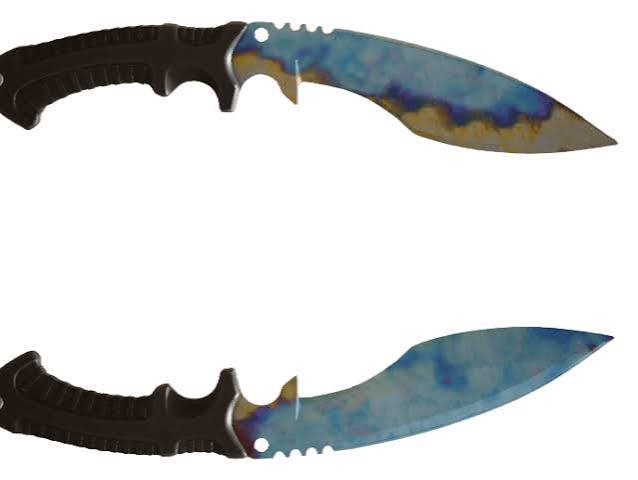
A Kukri Knife Case Hardened can sell for a few hundred dollars — or tens of thousands. The difference often comes down to a single number: the pattern seed. If you want to understand what separates a standard Case Hardened from a true Blue Gem, this guide covers exactly that.
You will learn what a Kukri Blue Gem actually is, which pattern seeds matter most, why wear condition is not the main factor, and what realistic prices look like right now.
What a Kukri Blue Gem Actually Is
“Blue Gem” is a community trading term. Valve did not create it, and there is no in-game rarity tier with that label. It simply means a Case Hardened Kukri Knife where the blade is dominated by blue coloration — not purple, not gold, not a mixed mess of all three.
The Case Hardened finish works differently from most CS2 skins. Instead of a fixed pattern, it uses a random paint layout that is determined by the pattern seed assigned to each individual knife. Two knives with the exact same Case Hardened finish can look completely different from each other.
Think of the pattern seed like a stencil. The same paint gets applied every time, but the stencil shifts position — so one knife ends up mostly blue while another ends up mostly gold or purple. The stencil placement is locked to the seed number.
Not every Case Hardened Kukri with some blue qualifies as a Blue Gem. The term implies unusually high blue coverage, especially on the play side — the side of the blade that faces toward the player during normal gameplay. A knife with scattered blue patches and heavy gold or purple tones is just a regular Case Hardened knife, not a Blue Gem.
The Top Kukri Blue Gem Pattern Seeds
Collectors and traders have spent a lot of time mapping and ranking pattern seeds across Case Hardened knives. For the Kukri, the community has settled on three seeds as the clear top tier: 494, 575, and 770.
Seed 494
Seed 494 is widely considered the best Kukri Blue Gem pattern available. It consistently produces the highest blue coverage on the play side of the blade. If you are looking at Blue Gem Kukri listings and only have budget for one top-tier option, 494 is the seed most collectors want.
Seeds 575 and 770
Seeds 575 and 770 are also strong Blue Gem patterns. They produce excellent blue coverage and are genuinely desirable to collectors, but they generally rank below 494 in terms of demand and price. They are not consolation prizes — they are still premium patterns — but 494 sits at the top of the list.
What a Seed Number Alone Does Not Tell You
A high or interesting seed number by itself means nothing. Plenty of seed numbers produce weak or mixed patterns that no serious collector would call a Blue Gem. The only way to confirm a knife qualifies is to visually inspect the actual blue distribution on the blade.
When browsing listings, find the seed number first, then look at the screenshots or inspect the skin directly. Both steps matter. Do not skip the visual check just because the seed sounds promising.
Why Wear Condition Matters Less Than Pattern
Most CS2 skins follow a straightforward rule: lower wear means higher price. Factory New beats Minimal Wear, which beats Field-Tested, and so on. Blue Gem Kukri knives do not follow that rule the same way.
Here is a practical example. A Minimal Wear Kukri Case Hardened with mostly gold and purple tones is just a standard Case Hardened knife. It will sell at a standard Case Hardened price. A Field-Tested Kukri with seed 494 and near-full blue blade coverage is a Blue Gem — and it will sell for dramatically more, even though the wear condition is worse.
The blue distribution is what collectors are actually paying for. A cleaner surface finish does not compensate for a weak pattern. Buyers who sort listings by wear condition without checking the seed number often make two mistakes: they overpay for non-Blue Gem knives, or they scroll past legitimate Blue Gem deals because the wear tier looks unappealing.
Check the seed and inspect the blue coverage first. Treat wear condition as a secondary factor once you have confirmed you are looking at a real Blue Gem pattern.
How Much a Kukri Blue Gem Costs
Prices in this market are volatile, and any specific number can go out of date quickly. That said, it helps to understand the rough range.
A standard Case Hardened Kukri in Minimal Wear typically trades in the $200–$300 range. There is nothing wrong with that knife — it just does not have a strong Blue Gem pattern.
True Blue Gem examples with top seeds like 494 are a different category entirely. Clean examples with high-tier seeds have reportedly sold for $30,000–$40,000 or more. That gap exists entirely because of pattern seed demand, not because the knife itself is mechanically different.
Several factors push Blue Gem prices up or down:
- Pattern seed — 494 commands the highest prices; 575 and 770 follow
- Blue coverage percentage — more blue on the play side means higher value
- Wear tier — still a factor, just not the primary one
- Market activity — collector demand shifts over time, which moves prices in either direction
Valve does not set or guarantee these prices. Everything is market-driven, and values can change based on who is buying and selling at any given time. Treat any price you see as a reference point, not a fixed rate.
Where to Get a Kukri Knife Case Hardened
The Kukri Knife Case Hardened appears in the Gallery Case and the Kilowatt Case in CS2. You can get one by opening either of those cases, though the odds of getting a knife from a case opening are low, and the odds of landing a Blue Gem seed on top of that are much lower.
Most buyers skip case opening and go directly to the Steam Community Market or third-party trading platforms. On those platforms, you can filter by pattern seed or inspect listings before purchasing, which gives you actual control over what you are buying.
If you are specifically hunting a Blue Gem, buying directly is far more practical than hoping a case drop lands on seed 494. Use a reliable platform, confirm the seed number, inspect the blue coverage visually, and check recent sales to make sure the asking price is reasonable.
For more gaming guides and resource roundups, Bizblinks covers a wide range of topics worth bookmarking.
How to Verify a Blue Gem Before Buying
The process is straightforward once you know what to look for.
- Find the pattern seed listed in the item details or platform metadata
- Confirm the seed matches a known Blue Gem pattern — primarily 494, 575, or 770
- Inspect the skin in-game or review high-quality screenshots to check blue coverage on the play side
- Look at recent sales data for the same seed to gauge whether the price is fair
Do not rely on a seller’s description alone. Terms like “blue” or “mostly blue” are subjective and sometimes misleading. The seed number is objective — the visual inspection confirms whether the seed actually delivers on the blue coverage.
If a listing does not show the pattern seed or refuses to let you inspect the skin, that is a reason to be cautious.
Final Thoughts
The Kukri Blue Gem is one of the more straightforward collector items in CS2 once you understand how it works. The pattern seed determines everything. Seeds 494, 575, and 770 are the ones worth chasing. Wear condition matters, but it comes second to blue coverage on the play side.
Prices can be extreme at the top end, but there is a logical reason for that — collectors are paying for a specific visual outcome that only a handful of seed numbers can produce. If you are buying, verify the seed and inspect the knife before committing. If you are just learning the space, now you know what the community is actually talking about when they say Blue Gem.
Read Also: