


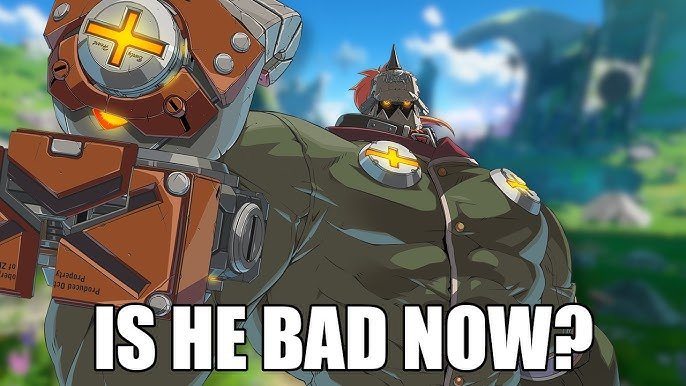
Potemkin is one of the most recognizable characters in Guilty Gear. He is a slow, armored giant who can end a round with a single grab. But there is more to him than raw power — both in the story and in how he plays, whether you are controlling him or facing him as a CPU opponent.
This article covers who Potemkin is in the Guilty Gear story, what makes him a grappler, his most important moves, and how AI-controlled Potemkin behaves. Understanding all of this will help you play better — whether you use him or fight against him.
Potemkin’s Background in the Guilty Gear Story
Potemkin was born into slavery under Zepp, a militaristic nation built on science and technology. He did not choose that life, but he made the most of the abilities he developed within it.
He played a part in the democratic revolution that overthrew Zepp’s dictatorship. After the coup succeeded and a new government took hold, Potemkin did not walk away. Instead, he stayed and committed himself to the new order.
Today, he serves as a member of Zepp’s elite presidential guard under President Gabriel — the same man who was once his instructor. Gabriel trusts Potemkin enough to give him secret missions involving Gears, and Potemkin accepts those missions out of genuine loyalty, not obligation.
What makes Potemkin interesting as a character is the contrast between his appearance and his personality. He is massive, armored, and visually intimidating. But he is also restrained, disciplined, and thoughtful. He does not fight because he enjoys it. He fights because he has a duty and a cause worth protecting.
What Makes Potemkin a Grappler Character
In fighting games, a grappler is a specific type of character. They move slowly, have limited mobility, but hit much harder than almost everyone else on the roster. Potemkin is the clearest example of this in Guilty Gear.
His core win condition is simple: get close enough to land a command grab. That grab deals enormous damage. One successful Potemkin Buster can shift the entire momentum of a round. That is what makes him dangerous.
But getting close is the hard part. His slow movement means every step forward is a calculated risk. Opponents know what he wants to do, so they will do everything possible to keep him at a distance. This creates a constant back-and-forth where spacing and positioning matter more than flashy combos.
Think of him like a slow tank in a strategy game. Hard to reach, difficult to stop once he closes in, but exposed and punishable if you play the range correctly. His heavy armor, massive gauntlets, and towering frame are not just visual choices — they signal exactly how he plays.
According to the Dustloop Wiki, Potemkin is Guilty Gear’s resident grappler, built around large attacks, big damage, and huge throws. That description has been true across every major entry in the series.
Potemkin’s Core Moves and When to Use Them
You do not need to know every move in his kit to understand how he works. Three tools form the backbone of his gameplan across most Guilty Gear titles.
Potemkin Buster
This is his signature command grab. The range is short, but the damage is enormous. His entire gameplan is built around setting up situations where this move can connect. If you are playing as Potemkin, every decision you make — every approach, every knockdown, every defensive moment — exists to create an opening for this move.
If you are playing against him, this is the move you are always trying to prevent. Respecting it too much leads to getting controlled by footsies. Respecting it too little means eating massive damage at close range.
Hammerfall
Hammerfall is an armored advancing attack. It helps Potemkin close the distance against opponents who are trying to keep him out with pokes and projectiles. The armor on this move means some attacks will not stop him during startup, which gives him a way to push forward when walking forward is too risky.
It is not unbeatable. Opponents can react and punish it with the right timing. But it forces them to make a decision, which is the point. Every moment an opponent spends thinking about Hammerfall is a moment Potemkin gains ground.
Slide Head
Slide Head is a ground-based attack that causes a knockdown. It also creates a shockwave effect that can catch opponents off guard and disrupt their neutral positioning. When it connects, Potemkin gets time to approach while the opponent recovers from the knockdown.
It is a setup tool. Landing Slide Head puts you in the kind of situation where a Potemkin Buster becomes a real threat. It shifts the pressure from neutral into a mix where the opponent has to guess correctly or take big damage.
Keep in mind that specific frame data and move properties vary between games. What is true in Xrd may not be identical in Strive. The general function of each move stays consistent, but always check game-specific resources before assuming the details are the same.
How AI-Controlled Potemkin Behaves
When you fight CPU Potemkin in the standard game modes, you are not facing a learning system or advanced machine intelligence. You are facing scripted, rule-based behavior. Once you recognize the patterns, you can exploit them.
The most common CPU habits include using Hammerfall to close distance, following knockdowns with Slide Head setups, and attempting Potemkin Buster when you are within close range. These are predictable once you have seen them a few times.
That predictability is actually useful. Fighting CPU Potemkin at a high difficulty level is a good way to practice the fundamentals of fighting a grappler. You can work on your backdash timing, practice jumping over Hammerfall at the right moment, and build muscle memory for avoiding command grabs at close range.
The CPU essentially runs a simple decision tree. If the opponent is far away, advance using Hammerfall or walk forward. If a knockdown is achieved, apply pressure with strikes and Potemkin Buster attempts. If the opponent jumps frequently, switch to anti-air options. It is not sophisticated, but it is consistent enough to be a useful training partner for learning grappler defense.
Where the CPU falls short is in reads and conditioning. A skilled human Potemkin player will bait reactions, delay timings, and create situations where you feel like you guessed correctly but still get grabbed. The CPU does not do this. It will not punish hesitation the way a human would, and it will not adapt to your patterns mid-match.
If you want more realistic pressure, community training tools are a better option. Recording sequences in training mode — for example, Slide Head into a meaty normal into a Potemkin Buster attempt — and setting the dummy to repeat it gives you something closer to real grappler pressure. You can then practice fuzzy jumps, backdashes, or reversal options in a controlled environment. Resources like Bizblinks can help you find guides and community tools that make training setups like this easier to build.
What This Means for Your Game
Whether you play Potemkin or fight against him, understanding his structure helps you make better decisions.
If you play him, your job is to create situations where the opponent has to guess. Hammerfall forces a reaction. Slide Head forces a recovery. Every tool he has is designed to narrow the distance and create a moment where Potemkin Buster becomes the correct answer. Play patiently and think about positioning before committing to an approach.
If you fight against him, respect the threat without being paralyzed by it. Stay at a range where his grab cannot reach you. Punish Hammerfall if you can react to it. Do not jump carelessly — good Potemkin players use anti-air tools to punish predictable jumps. When you knock him down, use that space to reset your positioning rather than pressing in unnecessarily.
Potemkin is also a solid teaching character for anyone new to fighting game fundamentals. His win conditions are clear. His weaknesses are clear. Learning to play around him — either as him or against him — builds the kind of spacing awareness and risk management that transfers to almost every other matchup in the game.
Final Thoughts
Potemkin is not a complicated character on the surface. His story is about loyalty and transformation — a man who escaped oppression and chose to serve something worth protecting. His gameplay reflects that same directness: slow, deliberate, and punishing when things go his way.
The CPU version of him is a decent training partner for learning grappler defense, but it has clear limits. Real improvement comes from understanding his actual gameplan and practicing against scenarios that reflect human decision-making.
If you take the time to understand how Potemkin works — his strengths, his patterns, and his limits — you will be better prepared to handle grapplers in general, not just in Guilty Gear, but across the broader genre.
Read Also: